Why Do Catholics Honour the Blessed Virgin Mary?
Short Answer
Catholics honour the Blessed Virgin Mary because God Himself honoured her in an extraordinary way by choosing her to be the Mother of His divine Son. Mary is not a goddess, not a fourth person of the Trinity and not a rival to Jesus Christ. She is entirely a creature, entirely dependent upon God, and everything that is great in her comes from His grace.
Sacred Scripture calls her “full of grace,” “blessed among women,” and “the mother of my Lord.” Mary herself, speaking under the inspiration of the Holy Ghost, prophesied:
“Behold from henceforth all generations shall call me blessed.” See Luke 1.
The Catholic Church teaches that Mary is truly the Mother of God, remained ever Virgin, was preserved by a unique grace of Christ from original sin from the first instant of her conception, and, having completed the course of her earthly life, was assumed body and soul into heavenly glory.
Catholics also ask for Mary's intercession, just as Christians ask one another to pray for them. But the Church makes an absolute distinction between adoration, which belongs to God alone, and the veneration given to the saints. St Thomas Aquinas explains that latria belongs to God alone; Mary, being a creature, receives not latria but the unique higher veneration traditionally called hyperdulia.
Properly understood, Marian doctrine does not distract from Jesus Christ. It tells us who Jesus Christ is, what God accomplished through the Incarnation, and what His grace can accomplish in a human creature perfectly united to Him.
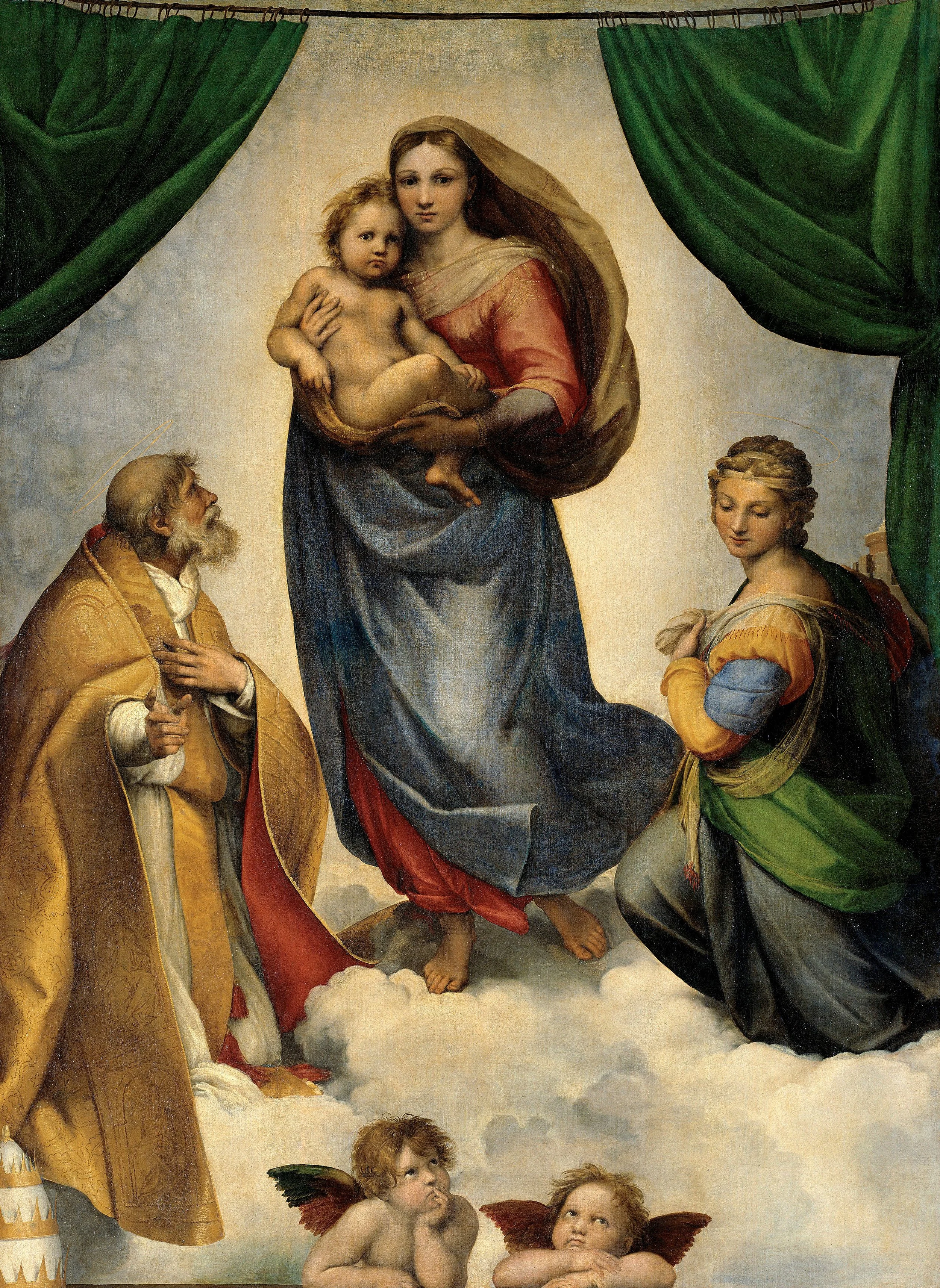
Raphael (1483–1520), The Sistine Madonna (1512–1513). Oil on canvas, Gemäldegalerie Alte Meister, Dresden. The Blessed Virgin presents the Christ Child to the world: her dignity as Mother of God derives entirely from the identity of her Son, Jesus Christ, true God and true man.
Why This Question Matters
Few Catholic practices are more frequently misunderstood than devotion to the Blessed Virgin Mary.
A sincere Protestant may encounter statues of Mary, the Rosary, Marian processions, titles such as Mother of God and Queen of Heaven, prayers asking for her intercession, and Catholic teaching about her Immaculate Conception and Assumption. It can appear that Catholics have placed another figure between the soul and Jesus Christ.
But the real Catholic doctrine is almost the reverse.
The more carefully we examine authentic Marian teaching, the more consistently it leads back to Christ.
Why is Mary Mother of God?
Because Jesus is God.
Why is Mary the New Eve?
Because Christ is the New Adam.
Why is Mary compared with the Ark of the Covenant?
Because she carried not merely tablets, manna or a sacred object, but the Incarnate Word Himself.
Why is Mary Queen?
Because her Son is the everlasting Davidic King.
Why is Mary immaculate?
Because God prepared in an extraordinary way the woman from whom the Word would take His human nature.
Why was Mary assumed into Heaven?
Because the victory of Christ over sin and death reached an extraordinary fulfilment in His Mother.
Marian doctrine therefore follows the biblical pattern:
shadow → fulfilment
and ultimately:
Mary → Christ
What the Catholic Church Teaches
Mary Is the Mother of God — Because Jesus Is God
The title Mother of God is sometimes misunderstood as though Catholics were trying to exaggerate Mary's importance. Historically, however, the title was defended principally because of what it tells us about Jesus Christ.
The doctrine about Mary protects the doctrine about Christ. Mary therefore helps answer one of Christianity's most important questions:
Who is Jesus Christ?
Jesus is not merely a holy man in whom God happened to dwell.
He is not one human person associated with another divine Person.
He is one divine Person, the eternal Son of God, possessing both a complete divine nature and a complete human nature.
The Person born of Mary at Bethlehem is therefore the same divine Person who is eternally begotten of the Father.
Mary is consequently called Theotokos — literally, God-bearer, traditionally rendered Mother of God.
Why the Council of Ephesus Defended Theotokos
The importance of the title became especially clear during the Nestorian controversy of the fifth century.
It would not be quite accurate simply to say that Nestorius denied that Christ was fully human. The underlying difficulty was rather that his Christology distinguished the humanity and divinity of Christ in such a way as to compromise the unity of Christ's Person.
Pope Pius XI, commemorating the Council of Ephesus in Lux Veritatis (1931), explained that the Nestorian position led toward recognising two persons in Christ, one divine and the other human, instead of the one divine Person of the Word possessing both natures.
That is why the controversy over Mary's title mattered so much.
The Council of Ephesus (AD 431), following St Cyril of Alexandria, declared:
“If anyone will not confess that Emmanuel is very God, and that therefore the Holy Virgin is the Mother of God … let him be anathema.”
The next anathema insists that the Word is united hypostatically to the flesh and is one Christ, God and man.
The logic is simple:
Emmanuel is truly God → Mary bore Emmanuel according to the flesh → therefore Mary is truly Mother of God
The Church was therefore not primarily asking:
How highly may we exalt Mary?
It was asking:
Who is the Child whom Mary bore?
The answer is:
God the Son truly made man.
Pope Pius XI summed it up beautifully:
“If the Son of the Blessed Virgin Mary is God, assuredly she who bore him is rightly and deservedly to be called the Mother of God.”
Mary Tells Us Who Jesus Is
This is one of the most important principles for understanding Marian doctrine.
Tell me who Mary's Son is, and I will tell you who Mary is.
If Jesus were merely a human person specially favoured by God, the title Mother of God would indeed be false. But if Jesus Christ is one divine Person who possesses both divine and human natures, then Mary truly bore God the Son according to His humanity.
The Council of Chalcedon (AD 451) later expressed the doctrine with extraordinary precision: Christ is one and the same Son, perfect in Godhead and perfect in manhood, truly God and truly man, existing in two natures without confusion or division, united in one Person.
Mary did not create Christ's divine nature.
She did not exist before God.
She is not Mother of the Father or Mother of the Holy Ghost.
But motherhood belongs to the person who is born, not merely to one part or nature of that person.
An ordinary mother does not create her child's soul, yet she is still mother of the child rather than merely “mother of the body.”
Likewise Mary did not originate the divinity of Christ.
Nevertheless, the Person whom she conceived and bore is God the Son.
That is why St Elizabeth, filled with the Holy Ghost, exclaims:
“Whence is this to me, that the mother of my Lord should come to me?” See Luke 1.
The Roman Catechism, promulgated after the Council of Trent, teaches the same Christological principle: Christ was perfect God and perfect man from the beginning of His conception, and Mary therefore truly and properly became Mother of God and man.
Marian doctrine begins with Christology.
Mary Is Ever Virgin
Catholic doctrine teaches that Mary was a virgin:
before Christ's birth
in giving birth
after Christ's birth
Her perpetual virginity is therefore not merely a devotional title. At the Annunciation Mary asks Gabriel:
“How shall this be done, because I know not man?” See Luke 1.
St Augustine of Hippo (AD 354–430), in Of Holy Virginity, 4, understood Mary's words as indicating that she had already dedicated her virginity to God before the Annunciation.
St Jerome (c. AD 347–420) wrote an entire treatise, Against Helvidius or The Perpetual Virginity of Blessed Mary (c. AD 383), answering the claim that references to the “brethren” of Jesus prove Mary later had other children.
The Roman Catechism teaches explicitly that Christ's birth did not diminish Mary's virginal integrity and describes her virginity as immaculate and perpetual.
References to Christ as Mary's firstborn do not require later children; “firstborn” was a legal and religious designation. Nor does Scripture's use of “until” necessarily imply that the opposite subsequently occurred.
The ancient Church therefore understood Mary not merely as the Virgin who conceived Christ, but as the Ever-Virgin Mother of God.
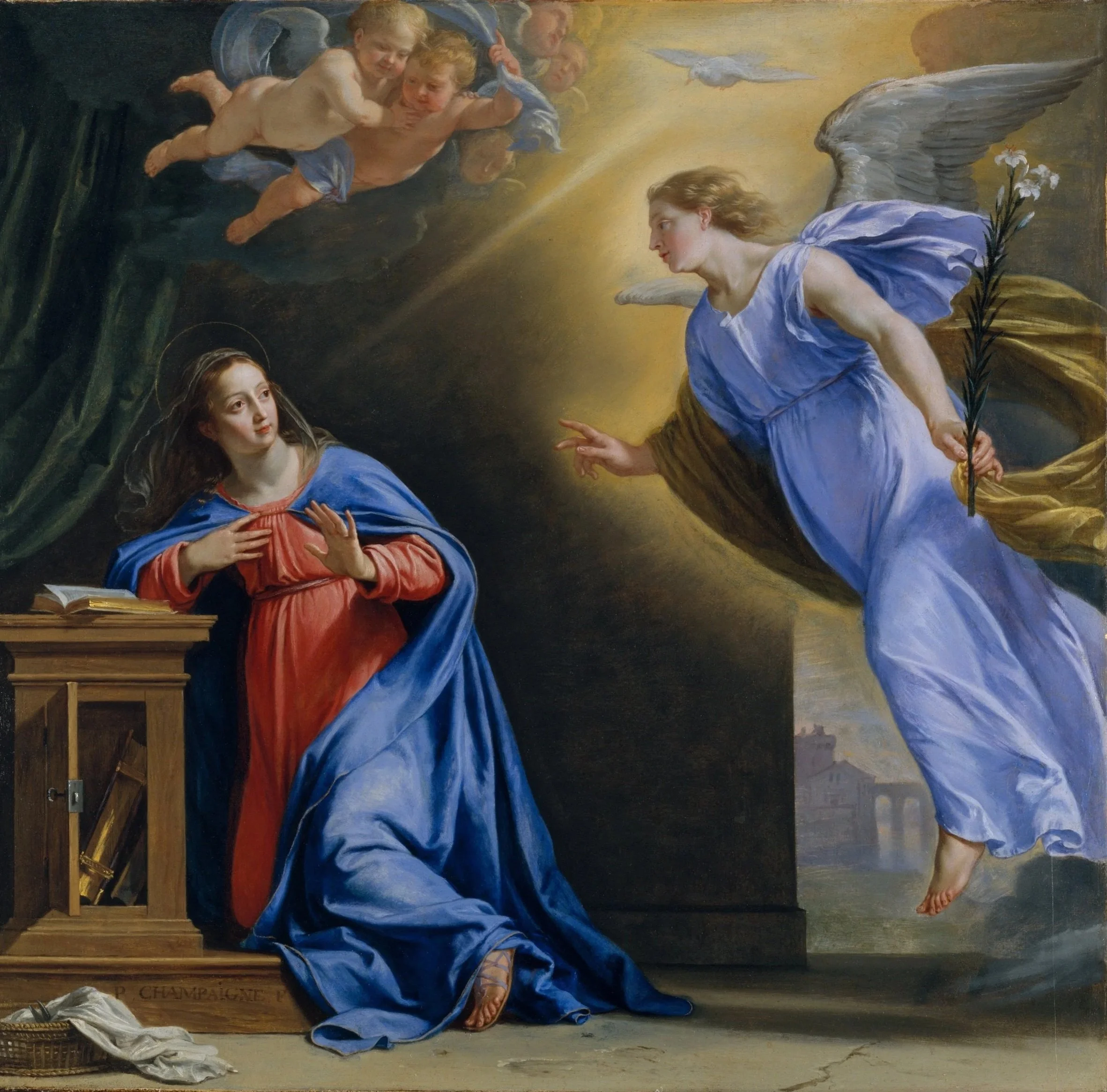
Philippe de Champaigne (1602–1674), The Annunciation (c. 1644). Oil on oak, Metropolitan Museum of Art, New York. The Archangel Gabriel announces that Mary will conceive the Son of God by the Holy Ghost; her faithful acceptance marks the moment when the eternal Word takes human nature in her womb.
Mary's Consecrated Virginity and the Temple Tradition
An ancient Christian tradition holds that Mary was presented in the Temple as a child and dedicated to God. This tradition appears in the second-century Protoevangelium of James, especially chapters 7–8, where Mary is described as being brought to the Temple and dwelling there in consecration.
It is important to distinguish theological certainty properly. The Protoevangelium of James is not inspired Scripture. Its individual narrative details therefore cannot be treated as though they were recorded in the canonical Gospels. Nevertheless, its antiquity shows that traditions concerning Mary's exceptional dedication to God were circulating extremely early.
Later Fathers also knew the Temple-presentation tradition.
The stronger theological point, however, does not depend upon proving every detail of Mary's childhood. St Augustine's interpretation of Luke 1:34 provides an independent patristic basis for the traditional belief that Mary had already chosen virginity before Gabriel appeared to her.
We should therefore distinguish:
Mary's perpetual virginity — Catholic doctrine
her prior dedication or vow of virginity — ancient patristic interpretation
specific details of her childhood residence in the Temple — ancient extra-biblical tradition
These propositions do not possess the same theological authority.
The Immaculate Conception
The Immaculate Conception does not mean the virginal conception of Jesus. It concerns Mary's own conception.
Pope Pius IX solemnly defined in Ineffabilis Deus (8 December 1854) that the Blessed Virgin Mary, from the first instant of her conception, by a singular grace and privilege of Almighty God and in view of the merits of Jesus Christ, was preserved from every stain of original sin.
Mary therefore needed Jesus Christ as her Saviour.
The doctrine does not remove her from Christ's redemption.
It teaches that Christ redeemed her in an exceptionally perfect manner.
An ordinary sinner may be compared to someone who falls into a pit and is rescued. Mary's preservation may be compared to someone whom the rescuer prevents from falling into the pit in the first place. Both are saved. The second is saved preventively.
Thus Mary could truly say:
“My spirit hath rejoiced in God my Saviour.” See Luke 1.
Why Was the Immaculate Conception Fitting?
God was not compelled by some necessity outside Himself to preserve Mary from original sin. The question is rather one of divine fittingness and revealed privilege.
Consider who Mary was to become.
The eternal Word would take His human nature from her.
She would carry the Incarnate Son of God within her body.
She would become the living Mother of Emmanuel.
The biblical types therefore acquire extraordinary significance. The Old Testament Ark was consecrated because it bore objects associated with God's covenant. How much more fitting that the woman who would bear the Word made flesh Himself should be uniquely prepared by grace.
The first Gospel prophecy in Genesis also presents a total opposition between the serpent and the woman:
“I will put enmity between thee and the woman, and thy seed and the seed of her.” See Genesis 3.
Pius IX appealed to this ancient Christian interpretation when defining the Immaculate Conception, and Pope St Pius X later connected Mary's complete opposition to the serpent with her preservation from original sin.
Gabriel's salutation further reveals the extraordinary grace given to Mary:
“Hail full of grace, our Lord is with thee.” See Luke 1.
No single verse by itself contains the entire later dogmatic formula. Rather, Scripture, Tradition and the Church's authoritative teaching converge upon the doctrine ultimately defined by Pius IX.
The Assumption of Mary
Catholic doctrine teaches that, having completed the course of her earthly life, Mary was assumed body and soul into heavenly glory.
The distinction between Ascension and Assumption is important.
Christ ascended into Heaven by His own divine power.
Mary, being a creature, was assumed by the power of God.
The Catechism of St Pius X makes exactly this distinction. Pope Pius XII solemnly defined in Munificentissimus Deus (1 November 1950):
“The Immaculate Mother of God, the ever Virgin Mary, having completed the course of her earthly life, was assumed body and soul into heavenly glory.”
The definition does not determine as part of the dogma whether Mary died immediately before the Assumption. The ancient Dormition tradition strongly speaks of her death, and this is the common traditional view, but the defined wording itself says only that she had completed the course of her earthly life.
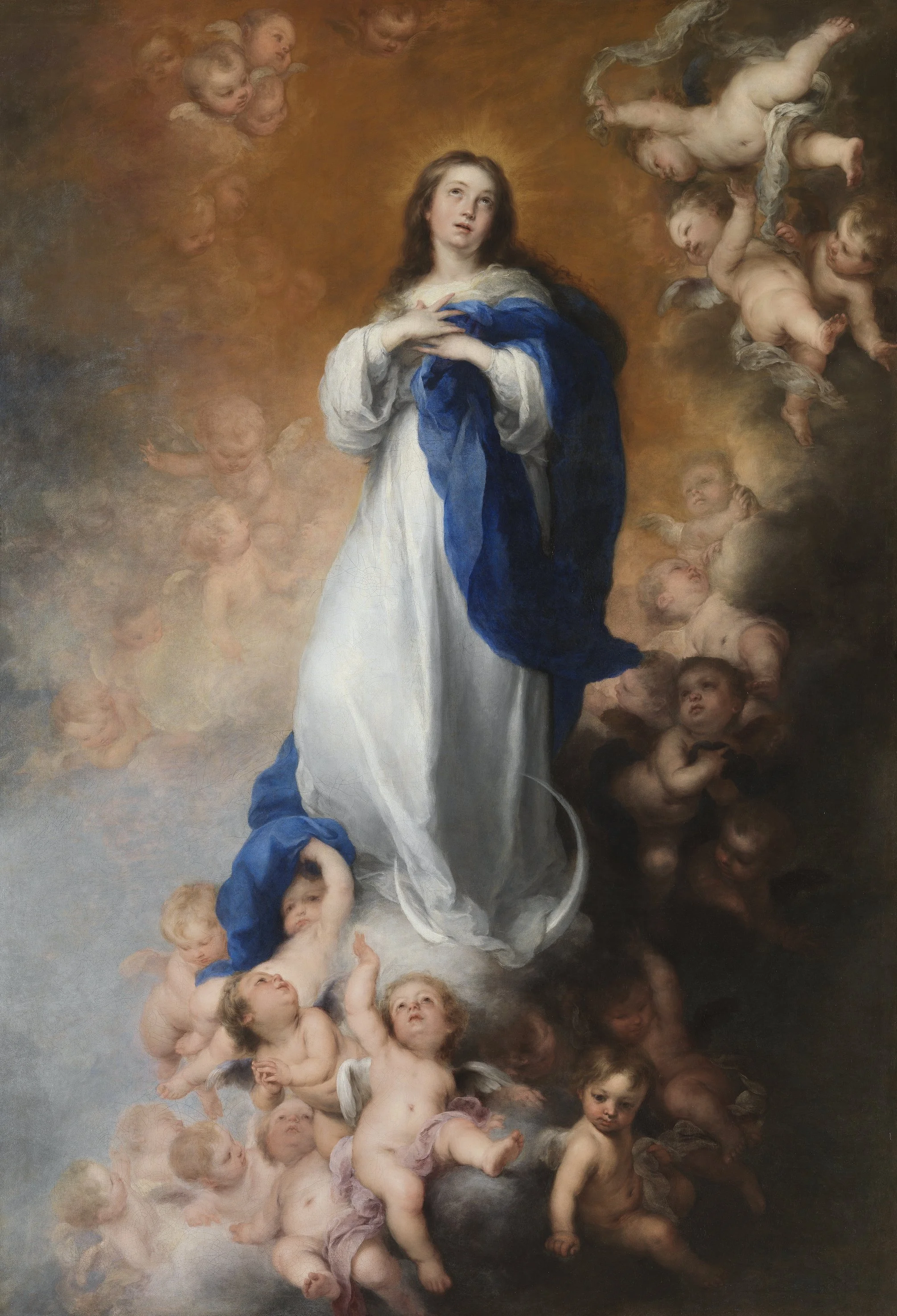
Bartolomé Esteban Murillo (1617–1682), The Immaculate Conception of Los Venerables (1660–1665). Oil on canvas, Museo Nacional del Prado, Madrid. The Immaculate Virgin stands upon the crescent moon amid heavenly light and angels, expressing her unique preservation from original sin and recalling the imagery of the Woman clothed with the sun.
Historical and Theological Evidence
Old Testament Types and Their Greater Fulfilment
Mary does not suddenly appear in the New Testament without preparation. God frequently prepares New Covenant realities through Old Testament types, shadows and figures. The fulfilment is greater than the shadow.
| Type or Shadow | Old Testament Reality | Greater Fulfilment |
|---|---|---|
| Eve | A virgin listens to the serpent and participates in Adam's disobedience | Mary believes Gabriel and freely cooperates in the coming of Christ the New Adam |
| Woman of Genesis 3:15 | A woman and her seed are placed in enmity with the serpent | Christ conquers Satan; Mary is intimately associated with the promised victory |
| Ark of the Covenant | Sacred vessel associated with God's covenant and presence | Mary carries the Incarnate Word Himself |
| Davidic Queen Mother | Mother of the king receives a throne and honoured place at his right hand | Mary is Mother of Christ the everlasting Davidic King |
| Consecrated sanctuary | What belongs particularly to God is set apart for Him | Mary's perpetual virginity and unique consecration to God |
| Woman clothed with the sun | Heavenly woman crowned with twelve stars gives birth to the Messianic ruler | Traditional Catholic interpretation applies the vision to Mary while recognising its wider ecclesial significance |
| Enoch and Elias | God extraordinarily translates human persons from ordinary earthly life | They show that bodily translation by divine power is biblical; Mary's Assumption is a distinct revealed privilege |
Eve → Mary the New Eve
One of the earliest Marian teachings outside the New Testament is the comparison of Eve and Mary. The New Testament itself explicitly identifies Christ as the New Adam. The early Fathers then recognised a corresponding Eve–Mary parallel.
St Justin Martyr (c. AD 100–165), writing in Dialogue with Trypho (c. AD 155), chapter 100, contrasts Eve and Mary.
Eve, still a virgin, received the serpent's word and brought forth disobedience.
Mary, a virgin, received Gabriel's word in faith and obedience, and through her the Saviour entered the world.
St Irenaeus of Lyons (c. AD 130–202) develops the parallel even more strongly in Against Heresies (c. AD 180), III.22.4:
“the knot of Eve's disobedience was loosed by the obedience of Mary.”
The contrast is therefore:
Eve hears the fallen angel → disbelieves God → disobeys
Mary hears Gabriel → believes God → obeys
Yet Mary is not placed on the same level as Christ. The fundamental parallel remains:
Adam → Christ the New Adam
and, subordinate to it:
Eve → Mary the New Eve
The Roman Catechism explicitly uses this same Eve–Mary typology, teaching that as Eve's belief in the serpent helped bring death, Mary's belief in the angel became an instrument through which Christ, the source of life, entered the world.
This is not medieval invention. The pattern is visible in second-century Christianity.
Genesis 3:15 — The Woman and the Serpent
Immediately after the Fall, God tells the serpent:
“I will put enmity between thee and the woman, and thy seed and the seed of her.” See Genesis 3.
This is traditionally known as the Protoevangelium, the first Gospel promise. The principal fulfilment is Jesus Christ's victory over Satan. But Catholic tradition also sees the Woman associated with the victorious Seed.
Theologically the progression is:
serpent → Eve → Fall
followed by:
serpent opposed by the Woman → Mary's Seed → Christ's victory
Mary's role is entirely dependent upon Christ. She does not conquer Satan independently. She is associated with the Redeemer because God chose her to become the Mother of the Redeemer.
This typology helps explain the fittingness of the Immaculate Conception: the woman placed in such complete opposition to the serpent is understood in Catholic tradition as specially preserved by the grace of her Son.
Mary as the Ark of the New Covenant
The Ark of the Covenant was one of the holiest objects of the Old Testament. It signified God's covenant and presence among Israel.
St Luke's account of Mary's Visitation contains striking parallels with David and the Ark in 2 Kings 6.
David asks:
“How shall the ark of the Lord come to me?”
Elizabeth asks:
“Whence is this to me, that the mother of my Lord should come to me?”
David leaps before the Ark.
The unborn St John leaps in Elizabeth's womb before Mary carrying Christ.
The Ark remains in the house of Obededom for three months.
Mary remains with Elizabeth for approximately three months.
Compare 2 Kings 6 with Luke 1.
The fulfilment is greater than the shadow. The Ark contained sacred signs of the Old Covenant. Mary carried Jesus Christ Himself.
Thus:
Old Ark → carried signs of God's covenant
Mary → carries God the Word made flesh
This does not mean that Scripture explicitly contains the sentence “Mary is the Ark of the New Covenant.” It is a traditional typological reading arising from the biblical parallels and the Church's broader Marian tradition.
A further striking sequence appears in the Apocalypse. At the end of chapter 11, St John sees:
“the ark of his testament”
in the heavenly temple. See Apocalypse 11:19.
Immediately afterwards:
“A great sign appeared in heaven; a woman clothed with the sun.” See Apocalypse 12.
The chapter divisions were not part of St John's original composition. The Ark and the Woman therefore appear in immediate literary succession.
The connection does not constitute a standalone proof of every Marian doctrine, but within the wider biblical pattern it is highly significant.
The Queen Mother, Cana and Maternal Intercession
The Old Testament Davidic kingdom provides another important background to Mary's queenship. The king often had many wives. The stable royal figure beside him was therefore not necessarily his wife but his mother, the gebirah or queen mother.
A particularly striking scene occurs when Bethsabee, the mother of Solomon, enters the royal court. Scripture says:
“the king arose to meet her, and bowed to her, and sat down upon his throne: and a throne was set for the king's mother, and she sat on his right hand.” See 1 Kings 2:19.
Notice what the text says.
The king possesses his throne.
But another throne is set for the king's mother.
She sits at his right hand.
She also presents a petition to the king.
This provides important Old Testament background for the traditional Catholic understanding of Mary as Queen Mother and intercessor. Gabriel tells Mary that her Son will receive:
“the throne of David his father”
and that:
“of his kingdom there shall be no end.” See Luke 1.
If Jesus is the everlasting Davidic King, Mary is the Mother of the King.
Pope Pius XII explains in Ad Caeli Reginam (1954) that the principal foundation of Mary's queenship is precisely her Divine Motherhood and the kingship of Christ.
The biblical pattern is therefore:
Davidic King → Queen Mother → honoured place → maternal petition
fulfilled more greatly in:
Christ the everlasting King → Mary His Mother → heavenly queenship → maternal intercession
The type must not be exaggerated, but neither should Mary's maternal influence be understated. Mary does not possess authority over Christ as though a creature could command God. Yet Scripture shows that her maternal intercession carries extraordinary weight.
At Cana, Mary does not merely observe that the wine has failed. She brings the need directly to Jesus:
“They have no wine.”
Although Our Lord replies, “Woman, what is that to me and to thee? my hour is not yet come,” Mary immediately tells the servants:
“Whatsoever he shall say to you, do ye.” See John 2:3–5.
Her words reveal remarkable confidence that Christ will act—and He does. His first public miracle follows her intervention. Cana therefore gives us a biblical picture of Mary's intercession:
the Mother presents the need; she confidently directs others to obey her Son; Christ freely grants the favour according to His divine wisdom and will.
Mary does not command Christ by authority over Him, but as His Mother she exercises a unique maternal intercession which He freely chooses to honour. Thus the Davidic pattern remains:
Davidic King → honoured Queen Mother → maternal petition
fulfilled more greatly in:
Christ the everlasting King → Mary His Mother → maternal intercession before the King.
Apocalypse 12 — The Woman Clothed with the Sun
St John writes:
“A great sign appeared in heaven; a woman clothed with the sun, and the moon under her feet, and on her head a crown of twelve stars.”
She gives birth to a male child:
“who was to govern all nations in an iron rod.” See Apocalypse 12.
This is clearly Messianic imagery. The Woman has a wider corporate or ecclesial significance connected with the people of God and the Church. But Catholic teaching also explicitly recognises a Marian meaning.
Pope St Pius X writes in Ad Diem Illum Laetissimum (1904):
“Everyone knows that this woman signified the Virgin Mary, the stainless one who brought forth our Head.”
He interprets her mysterious travail as Mary's spiritual motherhood and intercession for the members of Christ rather than as requiring physical labour pains at Christ's Nativity.
The vision therefore brings several themes together:
woman
Messianic Child
dragon or ancient serpent
heavenly glory
crown
spiritual offspring
This resonates strongly with the Woman promised against the serpent in Genesis 3.
The Ark the Queen Mother and the Woman in Heaven
These types should not be treated as three unrelated curiosities. They converge upon the mystery of Christ.
Ark → Mary carries the Incarnate Word
Queen Mother → Mary is Mother of the everlasting King
Woman of Genesis → Mary associated with the victorious Seed
Woman of Apocalypse → Mother of the Messianic ruler shown in heavenly glory
The types become intelligible because of who Jesus is. Marian theology remains Christological from beginning to end.
The Early Church Fathers
Marian doctrine did not suddenly emerge in the medieval period. The early evidence is substantial.
St Justin Martyr (c. AD 100–165), Dialogue with Trypho (c. AD 155), 100, compares the virgin Eve's disobedience with the Virgin Mary's faith.
St Irenaeus of Lyons (c. AD 130–202), Against Heresies (c. AD 180), III.22.4, describes Mary's obedience as loosening the knot tied by Eve's disobedience.
St Gregory Nazianzen (c. AD 329–390) defended the title Mother of God in the fourth-century Christological controversies.
St Augustine of Hippo (AD 354–430), Of Holy Virginity, 4, interpreted Mary's words at the Annunciation as evidence of a prior dedication to virginity.
St Jerome (c. AD 347–420), Against Helvidius (c. AD 383), defended Mary's perpetual virginity against arguments based upon the brethren of Christ.
St John Damascene (c. AD 675–749) strongly witnessed to the traditional belief in Mary's bodily glorification. His Second Homily on the Dormition, especially section 14, argues that it was fitting that the body which bore the Creator and preserved virginity should not remain subject to corruption. Pius XII appealed to this patristic testimony when defining the Assumption.
The Fathers do not possess the same authority as a solemn dogmatic definition. Their importance here lies especially in demonstrating the antiquity and continuity of beliefs that the Church later defined more precisely.
Enoch Elias and the Assumption
A common objection says that bodily entrance into the heavenly realm is impossible for anyone except Christ. Scripture itself shows that the question is more complicated.
Concerning Enoch, St Paul writes:
“By faith Henoch was translated, that he should not see death.” See Hebrews 11:5.
Concerning Elias, Scripture describes his extraordinary departure in the fiery chariot and whirlwind. These passages do not prove Mary's Assumption. Mary's Assumption rests upon the Church's received revelation and authoritative teaching.
But Enoch and Elias demonstrate a narrower point:
bodily translation by the power of God is not foreign to biblical revelation.
The New Covenant fulfilment is again greater. Mary's Assumption is connected with her unique relation to Christ, her Divine Motherhood, her Immaculate Conception, and Christ's victory over sin and death.
Why Catholics Ask Mary to Intercede
Catholic prayer to Mary does not treat her as the source of grace independent of God. All grace comes ultimately from God.
Jesus Christ alone is the Redeemer whose sacrifice merits man's reconciliation with God. Nevertheless, Scripture commands Christians to pray for one another. If asking another Christian on earth to pray for us does not diminish Christ, neither does asking the saints in Heaven to pray for us.
The Apocalypse depicts heavenly beings presenting prayers before God. See Apocalypse 8.
The Council of Trent, Session XXV (1563) solemnly teaches that the saints reigning with Christ offer their prayers to God for men and that it is good and useful to invoke their intercession through Jesus Christ our Lord, who alone is our Redeemer and Saviour.
Mary's intercession is simply the supreme example of this communion because she is the Mother of Christ.
Cana — A Biblical Picture of Marian Intercession
Cana provides the clearest Gospel example of Mary's maternal intercession. As already seen above, she notices the need, brings it to Christ, confidently tells the servants to obey Him, and Christ performs His first public miracle. See John 2:1–11.
The scene therefore illustrates the Catholic understanding of Marian intercession particularly well:
Mary presents the need; Christ remains the source of the grace and freely grants the favour according to His divine will.
Veneration Is Not Worship
This distinction is essential. Traditional Catholic theology distinguishes:
Latria — adoration owed to God alone.
Dulia — religious veneration given to God's saints.
Hyperdulia — the unique higher veneration accorded to Mary because she is the Mother of God.
St Thomas Aquinas addresses the question directly in Summa Theologiae, III, q.25, a.5. He states:
“The Mother of God is a mere creature. Therefore the worship of latria is not due to her.”
He then explains that Mary receives dulia in a higher degree than the other saints because of her Divine Motherhood, hence hyperdulia.
The Catechism of St Pius X teaches the same distinction:
God is adored because of His infinite excellence.
The saints are honoured and venerated as God's friends and intercessors.
Mary receives the special veneration called hyperdulia.
The Council of Trent likewise distinguishes veneration of saints and images from the adoration owed to God. Mary therefore remains infinitely beneath the Holy Trinity. There is an immeasurable difference between:
Creator
and:
creature
Mary belongs entirely on the creature side of that distinction. She is the greatest of creatures because of what God has done in her — not because she possesses divinity.
Common Objections
Objection 1: “Calling Mary Mother of God makes her greater than God.”
No. “Mother of God” identifies the Person she bore. It does not claim she caused the divine nature to exist.
The Son is eternally begotten of the Father according to His divinity. In time, that same eternal Son took a true human nature from Mary. The title therefore protects the doctrine of the Incarnation.
The Church did not define Theotokos in order to turn Mary into a goddess. It defended Theotokos because separating Mary from the divine identity of her Son risked separating Christ Himself into two subjects.
Objection 2: “Nestorius only wanted to protect Christ's humanity.”
The Nestorian controversy was more complex than a slogan. The Catholic objection was not that distinction between Christ's divine and human natures is wrong. The Church itself insists that the two natures remain distinct.
The error was the tendency to make the distinction so strong that Christ's unity as one divine Person was compromised. Pope Pius XI explained the Nestorian position precisely in these terms in Lux Veritatis. Chalcedon subsequently safeguarded both truths simultaneously:
Christ is fully God.
Christ is fully man.
Christ is one Person.
That is precisely why Mary is Theotokos.
Objection 3: “Jesus had brothers so Mary cannot have remained a virgin.”
Scripture certainly speaks of the “brethren” of Jesus. The Catholic position does not deny these passages. It denies that the term necessarily means biological children subsequently born of Mary.
Biblical kinship terminology can be broader than modern English usage. St Jerome addressed precisely this objection in the fourth century in Against Helvidius.
More importantly, Mary's perpetual virginity is independently witnessed in ancient Christian doctrine and liturgical tradition.
Objection 4: “If Mary was immaculate she did not need a Saviour.”
The dogma says exactly the opposite. Pius IX defined that Mary's preservation occurred through the merits of Jesus Christ.
She was not outside Christ's redemption. She experienced its most perfect preventive application. Mary therefore rightly calls God:
“my Saviour.”
Objection 5: “The Assumption is nowhere explicitly narrated in Scripture.”
That is correct if “explicitly narrated” means a canonical historical account comparable to Christ's Ascension. No biblical verse says:
“Mary was assumed body and soul into Heaven on this day.”
But Catholic Christianity does not hold that every revealed truth must appear in Scripture as an explicit sentence. The doctrine rests upon Sacred Tradition and the Church's teaching authority, while remaining deeply harmonious with Scripture.
Pius XII's Munificentissimus Deus reviews liturgical tradition, Fathers, theologians and the theological fittingness of Mary's bodily glorification before issuing the solemn definition.
Objection 6: “There is one Mediator between God and men.”
Absolutely. Jesus Christ is the unique Mediator of redemption because He alone reconciles mankind to God through His own merits and Sacrifice.
But Scripture simultaneously commands Christians to intercede for one another. Subordinate intercession therefore does not compete with Christ's unique mediation.
The Catechism of St Pius X explains that Christ alone, through His own merits, reconciles us to God, whereas Mary and the saints assist us by prayer through the merits of Christ. Their intercession depends entirely upon Him.
Objection 7: “Queen of Heaven is a pagan title.”
Scripture condemns worship offered to a false pagan deity called the “queen of heaven.”
That tells us nothing against the completely different Christian claim that the Mother of Christ the King is a queen. The Catholic argument does not arise from paganism. It arises from:
Christ's Davidic kingship
plus:
the biblical institution of the queen mother
plus:
Mary's Divine Motherhood
The queen mother in the Davidic kingdom receives a throne at the king's right hand in 1 Kings 2:19. Christ receives the eternal throne of David in Luke 1:32–33. Mary is His Mother.
Pius XII therefore teaches that Mary's royal dignity follows principally from her Divine Motherhood and the kingship of Christ.
What We Can and Cannot Conclude
Defined Catholic doctrine: Mary is truly the Mother of God.
Defined Catholic doctrine: Jesus Christ is one divine Person, truly God and truly man.
Defined Catholic doctrine: Mary remained perpetually Virgin.
Defined Catholic doctrine: Mary was preserved from original sin from the first instant of her conception by a unique grace of God through the merits of Jesus Christ.
Defined Catholic doctrine: Mary was assumed body and soul into heavenly glory.
Defined Catholic doctrine: the saints in Heaven pray for the faithful and may properly be invoked for their intercession.
Traditional Catholic theological teaching: Mary receives hyperdulia, a veneration uniquely greater than that accorded to the other saints but infinitely beneath the adoration given to God.
Very ancient patristic teaching: Mary is the New Eve whose obedient faith corresponds antithetically to Eve's disobedience.
Traditional Catholic typology: Mary may properly be understood as the Ark of the New Covenant.
Traditional Catholic typology: the Davidic queen mother provides genuine biblical background for Mary's queenship.
Pre–Vatican II papal interpretation: the Woman clothed with the sun in Apocalypse 12 has a genuine Marian meaning, although the vision also possesses a broader ecclesial dimension.
Ancient extra-biblical tradition: Mary was presented in the Temple during childhood. This tradition is ancient and entered Christian liturgical life, but the detailed story is not recorded in canonical Scripture.
Patristic interpretation: Mary's words in Luke 1:34 were understood by St Augustine as indicating a prior dedication to virginity.
Not defined by the Assumption dogma: whether Mary physically died immediately before being assumed. The traditional Dormition doctrine strongly favours her death, but Pius XII's dogmatic formula itself does not define that question.
Not established by Scripture: that Moses was bodily assumed into Heaven. Deuteronomy says that Moses died and was buried; Jude 9 mentions the dispute over his body but does not teach his assumption.
These distinctions allow Marian doctrine to be defended confidently without pretending that every ancient tradition, typological interpretation or devotional belief has the status of defined dogma.
Conclusion
Catholics honour the Blessed Virgin Mary because God honoured her first. He chose her to become the Mother of His eternal Son. And that fact tells us something decisive about Jesus Christ.
Mary is Mother of God because Jesus is God.
The title Theotokos is therefore not merely a Marian title. It is a confession of the Incarnation. The whole biblical progression points in the same direction:
Eve → Mary the New Eve
the Woman opposed to the serpent → Mother of the victorious Seed
Ark of the Covenant → Mary carrying the Incarnate Word
Davidic Queen Mother → Mary Mother of Christ the King
consecrated sanctuary → Mary's perpetual virginity
extraordinary divine preparation → Immaculate Conception
Enoch and Elias translated by divine power → biblical demonstration that bodily translation is possible
Mother of the risen Christ → Mary assumed body and soul into heavenly glory
earthly Queen Mother interceding before the king → Mary interceding before Christ
Yet every arrow ultimately terminates in Jesus Christ.
Mary's Immaculate Conception comes through Christ's merits.
Her Divine Motherhood exists because Christ is God.
Her queenship exists because Christ is King.
Her intercession operates through Christ.
Her Assumption manifests Christ's victory.
Her holiness reflects Christ's grace.
And Mary's own command gives the perfect summary of genuine Catholic devotion to her:
“Whatsoever he shall say to you, do ye.” See John 2.
To honour Mary rightly is therefore not to stop at Mary. It is to follow the Mother to her Son.
Primary Sources
Sacred Scripture
Genesis 3, especially Genesis 3:15, the Protoevangelium and the Woman opposed to the serpent. Genesis 3
2 Kings 6, David and the Ark of the Covenant, important background for the Ark–Mary typology. 2 Kings 6
Luke 1, the Annunciation, “full of grace,” the Visitation, “Mother of my Lord,” Mary's fiat and Magnificat. Luke 1
John 2, the Wedding Feast of Cana and Mary's intercession. John 2
Hebrews 11, including Enoch's translation. Hebrews 11
Apocalypse 11, especially 11:19 and the Ark appearing in the heavenly temple. Apocalypse 11
Apocalypse 12, the Woman clothed with the sun and the Messianic Child. Apocalypse 12
St Justin Martyr (c. AD 100–165), Dialogue with Trypho (c. AD 155), 100, on Eve and Mary. Read St Justin Martyr — Dialogue with Trypho 100
St Irenaeus of Lyons (c. AD 130–202), Against Heresies (c. AD 180), III.22.4, on the New Eve and Mary's obedience. Read St Irenaeus — Against Heresies III.22.4
St Augustine of Hippo (AD 354–430), Of Holy Virginity, especially 4, on Mary's prior dedication to virginity. Read St Augustine — Of Holy Virginity
St Jerome (c. AD 347–420), Against Helvidius: The Perpetual Virginity of Blessed Mary (c. AD 383). Read St Jerome — The Perpetual Virginity of Blessed Mary
Council of Ephesus (AD 431), especially St Cyril of Alexandria's Twelve Anathemas against Nestorius, 1–2. Read the Council of Ephesus texts
Council of Chalcedon (AD 451), Definition of Faith concerning the one Person and two natures of Christ. Read the Council of Chalcedon definition
Roman Catechism / Catechism of the Council of Trent, Part I, Article III, on the Incarnation, Divine Motherhood, perpetual virginity and Mary as the New Eve. Read the Roman Catechism — Article III
Council of Trent (1545–1563), Session XXV, on the intercession and invocation of saints and the veneration of sacred images. Read Council of Trent — Session XXV
Pope Pius IX, Ineffabilis Deus, 8 December 1854, defining the Immaculate Conception. Read Ineffabilis Deus — Holy See archive
Pope St Pius X, Ad Diem Illum Laetissimum, 2 February 1904, on the Immaculate Conception, Marian devotion and Apocalypse 12. Read Ad Diem Illum Laetissimum — Holy See archive
Pope Pius XI, Lux Veritatis, 25 December 1931, on the Council of Ephesus, Nestorianism, Christ's one divine Person and Mary's Divine Motherhood. Read an English text of Lux Veritatis, Official Latin text — Holy See archive
Pope Pius XII, Munificentissimus Deus, 1 November 1950, defining the bodily Assumption of the Blessed Virgin Mary. Read Munificentissimus Deus — Holy See archive
Pope Pius XII, Fulgens Corona, 8 September 1953, on the Immaculate Conception and Mary's dignity as Mother of God. Read Fulgens Corona — Holy See archive
Pope Pius XII, Ad Caeli Reginam, 11 October 1954, on Mary's Queenship and its foundation in her Divine Motherhood and Christ's kingship. Read Ad Caeli Reginam — Holy See archive
St Thomas Aquinas (c. AD 1225–1274), Summa Theologiae, III, q.25, a.5, on latria, dulia and hyperdulia. Read Summa Theologiae III q.25 a.5
Catechism of St Pius X, on the Mother of God, Christ's one Person, the Assumption, invocation of saints, and the distinction between latria, dulia and hyperdulia. Read the Catechism of St Pius X
Further Reading
St John Damascene (c. AD 675–749), Second Homily on the Dormition of the Mother of God, particularly section 14, for the patristic argument concerning the fittingness of Mary's bodily glorification. Read selections from St John Damascene on the Dormition
St John Damascene, An Exposition of the Orthodox Faith, Book III, chapter 12, for a particularly clear patristic explanation of why Mary is properly called Mother of God. Read St John Damascene — Orthodox Faith III.12
Protoevangelium of James, chapters 7–8, for the ancient tradition of Mary's Presentation and childhood in the Temple. This should be read as an early extra-biblical witness, not as inspired Scripture. Read the Protoevangelium of James
Lateran Synod of AD 649, Canon 3, for an early formal confession of Mary as Mother of God and ever Virgin before, during and after Christ's birth. Read the text of Lateran Canon 3
The Roman Catechism, Article III, is especially valuable because it unites the Incarnation, Divine Motherhood, perpetual virginity and Eve–Mary typology in one traditional catechetical treatment. Read the Roman Catechism — Article III
Pope Pius XI, Lux Veritatis is particularly valuable for readers who want to understand why Theotokos is fundamentally a Christological doctrine rather than merely a Marian title. Read Lux Veritatis in English
Pope Pius XII, Munificentissimus Deus provides the most important pre–Vatican II magisterial synthesis of the scriptural, liturgical, patristic and theological tradition concerning Mary's Assumption. Read Munificentissimus Deus
Pope Pius XII, Ad Caeli Reginam gives the authoritative pre–Vatican II explanation of Mary's Queenship, its dependence upon Christ and its connection with her Divine Motherhood and intercession. Read Ad Caeli Reginam
Related Questions
Who Is Jesus Christ and What Does the Incarnation Mean?
What Are Sacred Scripture and Sacred Tradition?
Why Do Catholics Pray to the Saints?
What Is the Communion of Saints?
Why Do Catholics Use Statues Relics and Sacred Images?
Why Do Catholics Pray the Rosary?
What Is the Immaculate Conception?
Why Was Mary Assumed Body and Soul into Heaven?